
Dynamic Ontology in Smart Navigator: Context-Aware Knowledge Evolution for Hybrid Intelligence
Context-aware knowledge evolution for adaptive hybrid intelligence.
Nov 04, 2025
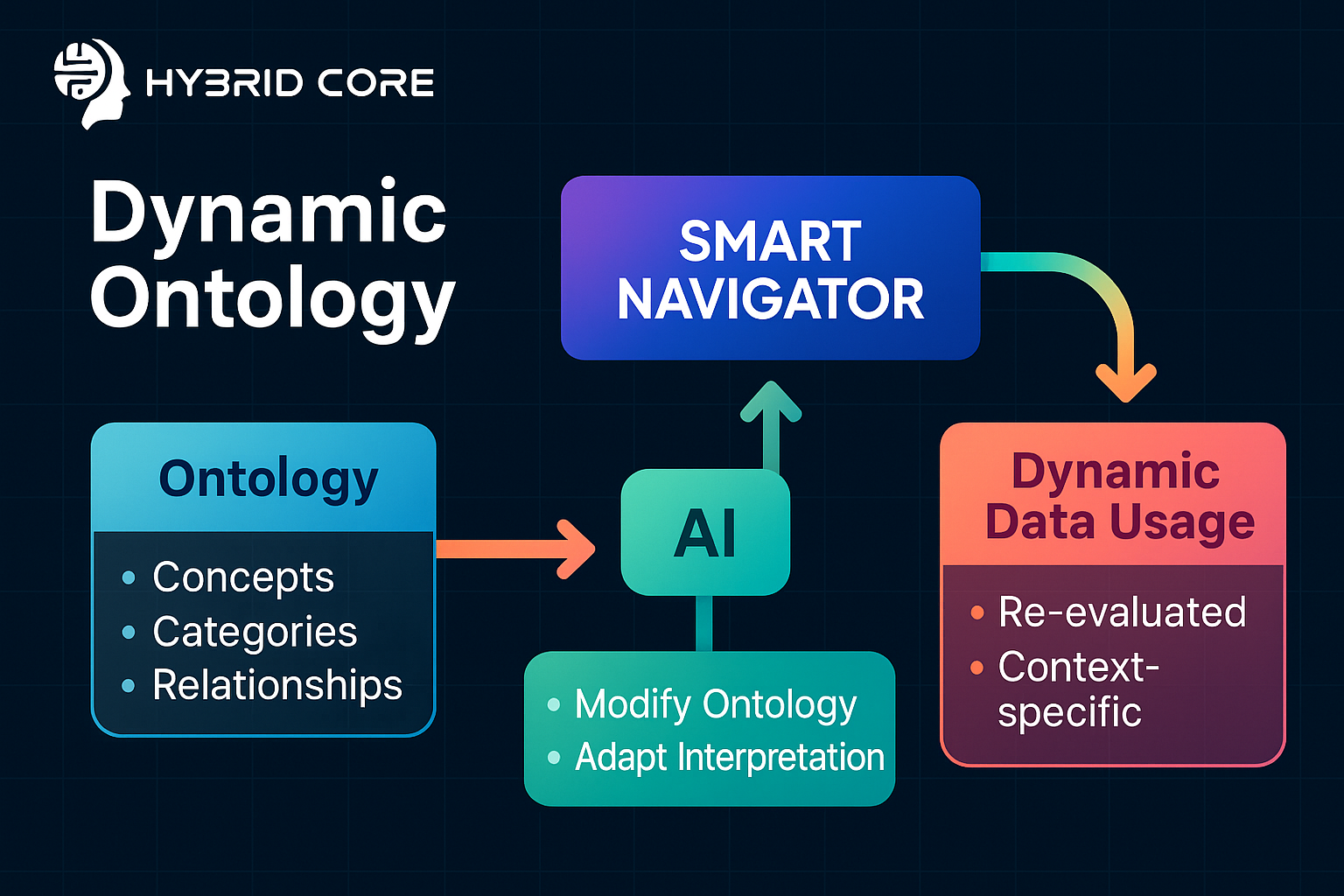
Smart Navigator introduces a novel approach to ontology management where both humans and AI agents can redefine and reinterpret the semantics of entities within the system. The Dynamic Ontology component is not only limited to user-driven modification but also enables contextual adaptation (adaptive intelligence), allowing AI to dynamically re-evaluate meanings and relationships based on data, observations, environmental context, relations, and scenario evolution.
This bidirectional ontology framework establishes a foundation for hybrid intelligence, where knowledge is no longer static but continuously co-evolves through human input and machine reasoning.
1. Introduction
Ontologies traditionally define structured representations of knowledge like concepts, relationships, and constraints, used by machines to interpret and reason about the world. However, in real-world systems, context and semantics are rarely static. A single concept may change meaning depending on circumstances, environment, or behavioral patterns.
Smart Navigator's Dynamic Ontology addresses this limitation by enabling both user-driven and AI-driven semantic evolution. The ontology serves as a living model that continuously adapts to new evidence and contextual data during simulation and decision processes.
This approach transforms the ontology from a fixed knowledge graph into an adaptive cognitive layer, ensuring that the system's understanding aligns with situational reality rather than rigid predefinitions.
2. Architecture of Dynamic Ontology
The dynamic ontology in Smart Navigator operates through a dual-control mechanism:
- Human-defined conceptual layer: Users create and structure the base ontology by defining classes, relationships, and properties through the Dynamic Ontology Screen.
- AI-driven adaptive layer: The system continuously analyzes streaming data, simulation outputs, and agent behaviors to reinterpret or reclassify entities and relationships dynamically.
This means that while users define an initial conceptual model (e.g., Entity A belongs to Category X), AI can, based on context or behavioral cues, assign an alternative semantic function or relation within a scenario (e.g., Entity A behaves more like Category Y under certain parameters).
This semantic elasticity allows Smart Navigator to reason beyond static ontological boundaries, providing context-aware interpretations essential for complex simulations.
3. Mechanism of Ontology Re-Evaluation
The AI component employs a semantic inference engine combined with data-driven pattern analysis. During runtime:
- The system evaluates usage patterns, interaction outcomes, and contextual variables.
- It detects semantic drift when an entity's behavior diverges from its defined role, then performs re-contextual classification, temporarily or permanently redefining relationships or categories to reflect new understanding.
These modifications are traceable and explainable, ensuring users can inspect when and why semantic reinterpretations occurred. The ontology thus operates as a self-adaptive semantic model, balancing user intent with AI-discovered meaning.
4. Advantages and Applications
Dynamic Ontology in Smart Navigator offers multiple technical advantages that extend beyond traditional semantic frameworks:
- Adaptive intelligence: Entities are understood relative to their situation, not just their original definition.
- Continuous learning: Ontological structures evolve with every iteration, integrating empirical data and simulation outcomes.
- Hybrid reasoning: Human experts define conceptual baselines; AI agents adjust and refine semantics dynamically.
- Explainability and trust: Every semantic adaptation is recorded, enabling users to trace and justify knowledge evolution.
- Semantic interoperability: The ontology layer provides a unifying semantic bridge across heterogeneous datasets, enabling seamless integration and comparative analysis across domains.
Furthermore, Smart Navigator leverages data fusion to a new level through integrated AI components, AI-powered simulation engines, and intelligently interacting multi-agent models.
These modules jointly process multi-source data streams by combining structured, unstructured, and temporal data into cohesive, context-aware representations. The result is a system capable of real-time adaptation and emergent behavior modeling, where ontology not only describes the world but actively evolves alongside simulated processes and agent interactions.
This framework proves especially powerful in applications such as:
- Policy and impact simulations, where evolving social or environmental contexts must be dynamically reflected.
- Urban planning and infrastructure optimization, where multi-source data fusion supports high-fidelity forecasting.
- Crisis management and resilience modeling, where agent behaviors shift dynamically under changing parameters.
- Complex network analysis, where the ontology evolves to reflect new patterns or relationships discovered by AI modules.
5. From Static Models to Semantic Evolution
Traditional decision-support systems rely on predefined semantics, constraining AI reasoning to a closed conceptual world. Smart Navigator's dynamic ontology breaks this limitation by enabling semantic evolution: an environment where definitions, meanings, and relationships adapt to reflect reality as it unfolds. This continuous re-evaluation process is a key step toward true hybrid intelligence, where humans define conceptual space and AI enriches it through contextual awareness and autonomous reinterpretation.
6. Conclusion
The Dynamic Ontology of Smart Navigator establishes a new paradigm in knowledge representation and reasoning. By combining human conceptualization with AI-driven semantic adaptation, it creates a system capable of understanding context, reinterpreting meaning, and evolving knowledge structures in real time.
This symbiotic approach ensures that Smart Navigator's simulations remain accurate, explainable, and reflective of dynamic real-world complexity by advancing the frontier of adaptive, hybrid-intelligence-based decision systems.
Posted on: Nov 04, 2025